There’s a particular moment in a sound bath — usually a few minutes in, once the initial strangeness of just lying there listening wears off — where you can watch people’s faces visibly soften. Shoulders drop. Breathing slows. It’s remarkable, honestly, how quickly sound can shift a nervous system, and it’s a big part of why this practice has found its way into so many wellness spaces in recent years.
The Basic Premise
Sound healing works with the idea that everything, including our bodies, is fundamentally vibrational. Cells, organs, energy centers — all of it has a frequency, a kind of resonant state. When we’re stressed, ill, or emotionally out of balance, that resonance can get disrupted. Sound healing uses specific tones, frequencies, and instruments to help the body and nervous system find their way back to a more coherent, balanced state — a process often described as entrainment, where your internal rhythms gradually sync with an external one.
This isn’t only a modern or fringe idea, either. Sound has been used therapeutically and spiritually across an enormous range of traditions — Tibetan singing bowls, gongs, drumming, chanting, mantra — long before “sound healing” became a phrase used in wellness spaces.
The Instruments and Techniques Involved
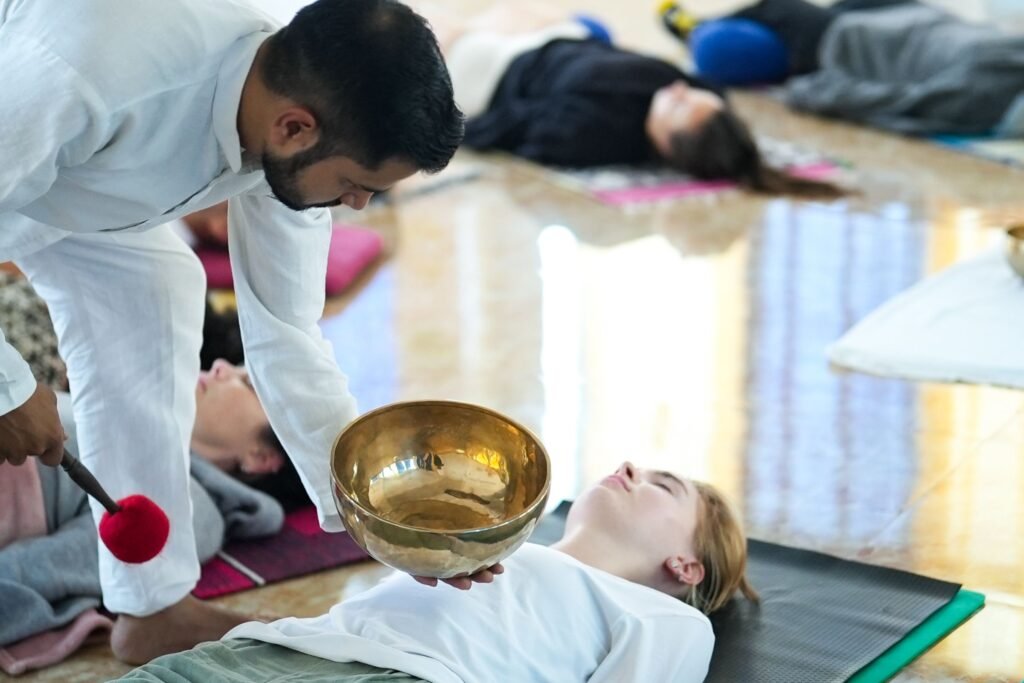
There’s a wide range of tools and techniques that fall under this umbrella: crystal or metal singing bowls, tuning forks, gongs, chimes, drums, and the human voice itself through toning, humming, or chanting — the sustained “Om” being one of the most recognizable examples. Each has a slightly different quality. Singing bowls tend to produce a rich, sustained resonance that seems to move through the whole body, not just the ears. Gongs can be more intense, almost physically felt as much as heard. Tuning forks are often used more precisely, placed near or on the body to target specific areas. Even something as simple as humming activates vibration in the chest, throat, and skull, and has its own calming effect on the vagus nerve.
What a Session Tends to Feel Like
Most sound healing sessions, often called sound baths, involve lying down comfortably, often with a blanket, while a practitioner moves through a sequence of instruments. There’s nothing you’re asked to do except receive. That’s part of what makes it so accessible even to people who find meditation difficult — you don’t have to try to quiet your mind. The sound does a lot of that work for you.
People commonly report a wide range of experiences: a sense of floating, vivid imagery, emotional release, sometimes tears without an obvious reason, sometimes falling into a state close to sleep. Others feel very little in the moment and then notice afterward that their sleep that night was unusually deep, or that a nagging tension had quietly disappeared.
What It’s Generally Used For
Sound healing is commonly used for stress and anxiety, difficulty relaxing or sleeping, and simply as a way to drop out of the constant mental noise most of us carry around all day. It’s also often used as a complement to more intensive inner work — after something like a deep hypnotherapy or subconscious session, sound can help integrate and settle what came up, rather than leaving someone feeling activated or unsettled.
Why It Resonates With So Many People
Of all the modalities out there, sound healing might be the one that requires the least explanation and delivers the most immediate, visible relief. You don’t need to understand vibration or resonance theory to feel your body let go the moment a bowl is struck nearby. It’s one of the more universally accessible doorways into this kind of work — no belief required, just a willingness to lie down and listen.